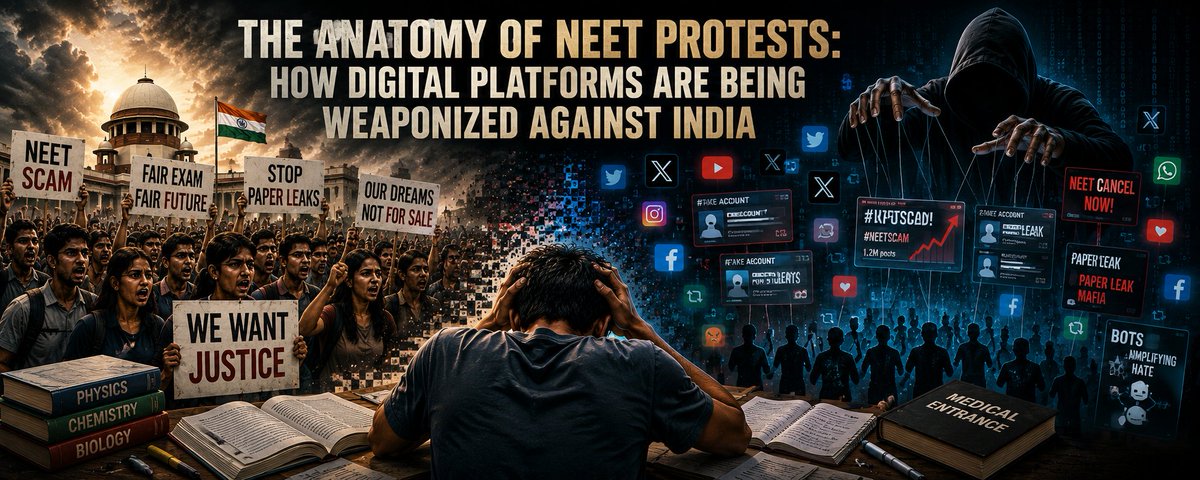
In recent months, the intense controversy surrounding the National Eligibility cum Entrance Test (NEET) has illuminated a troubling and highly calculated nexus between legitimate student grievances and orchestrated political subversion. When allegations of systemic irregularities and question paper leaks in the crucial medical entrance exam first surfaced, the Government of India swiftly initiated comprehensive corrective actions to uphold the uncompromised integrity of the nation’s educational framework. Acknowledging the distress of the aspirants, the authorities directed the National Testing Agency (NTA) to re-conduct the examinations for the affected candidates. The government went out of the way with Education Minister Dharmendra Pradhan admitting the lapses and the government even mobilised Indian Airforce to make sure that NEET papers are secured and not leaked again as lakhs of students would be affected once again.
The results of this re-NEET were subsequently declared with complete transparency, thereby offering a definitive and fair resolution to the aggrieved students. Furthermore, demonstrating a robust and unyielding commitment to democratic expression, the government allowed peaceful protests to continue unhindered at Jantar Mantar for nearly a month from June 20th to July 20th 2026. Students and concerned citizens were given the requisite space to voice their anxieties openly, without any state interference from Delhi Police or the Government. While the concerns of the students were genuine and the government should have addressed the demands of the students in legitimate manner. This is where we believe government miscalculated and should have reached out once NEET exam was done. But what followed later was nothing but weaponizing innocent minds using them cannon fodder in a confrontation with the states. The responsibility to order on any protests lies on the leaders who are leading it to make sure it does not go violent.
However, the true, manufactured nature of this movement was unmasked just as the commencement of the crucial upcoming Parliament session drew inevitably near. Almost on cue, a sudden and highly provocative march to the Parliament was announced. Leftist organizations, seasoned NGO activists, and opportunistic opposition political parties made a beeline to the protest site at Jantar Mantar in New Delhi. Rather than seeking educational reform, they actively began egging the students on, deliberately transforming a largely resolved grievance with re-exam into an engineered, high-stakes confrontation with the government deploying its carders among the innocent youth and using social media platforms like Instagram to spread misinformation.
This cynical hijacking of what was largely a student driven movement becomes even more glaring and indefensible when contrasted with the deafening silence surrounding similar, if not worse, examination paper leaks in non-NDA governed states. In Punjab & Karnataka, extensive state-level public commission and entrance exam leaks have occurred repeatedly, devastating the futures of countless local youth. In Punjab, Group-B officers recruitment exam (Naib Tehsildar, Treasury Officers, Senior Assistants etc., Dec 2025) Suspected paper leak; 22 of top 100 candidates from Bathinda; referred to Vigilance Bureau; probe still pending as of mid-2026. Other recruitment exams (e.g., Senior Assistant-cum-Inspector) saw paper-leak allegations as well.
In Karnataka, KPSC FDA (First Division Assistant) exam (Jan 2021) Question paper leaked; exam postponed; several arrests including a commercial tax inspector. Assistant Professors recruitment exam (Geography paper, March 2022) Leak alleged hours before exam; complaint filed by KEA. Gazetted Probationers (GP) Mains exam by KPSC (2025) Candidates alleged paper leaked/seal opened early at a Bengaluru centre. Yet, in these states, absolute zero accountability has been fixed, and these same self-proclaimed activists remain conspicuously absent from the streets in those states. Rather central government cancelled NEET-UG 2026 after the paper leak, handed probe to CBI, and conducted a re-exam with results declared on schedule. CBI arrested around 10-13 accused, including coaching institute owners, teachers, and others from Rajasthan, Maharashtra, and elsewhere.
This blatant hypocrisy lays bare the undeniable ulterior motives of the leftist agitators: their core objective is not the betterment of the student community, but the targeted, relentless destabilization of the central government. By callously exploiting the genuine anxieties of vulnerable students, they manufacture artificial outrage and seamlessly weaponize it for pure political mileage. The agenda is not paper leak or students concerns. If that wud be the case, where were these activists and politicians when IIT JEE paper leak happened in 1997, AIIMS entrance exam paper leak happened in 2006 & 2011, CBSE leak in 2005, Railway recruitment paper leak in 2012.
This modus operandi is deeply familiar to the Indian public; it is the exact, step-by-step blueprint deployed during the CAA-NRC protests. During those agitations, rampant misinformation regarding citizenship was systematically sown across digital platforms to create widespread panic, alienate communities, and ignite violent civic unrest. By decoding this pattern, it becomes evident how localized or resolved issues are artificially inflated through digital fear-mongering and coordinated on-ground mobilization, rapidly morphing into massive anti-state agitations.
The New Digital Megaphone: From Facebook to Discord
Ultimately, these manufactured crises serve a far more insidious geopolitical purpose. They purposefully transform the domestic socio-political landscape into a highly volatile playing ground for foreign forces and deeply entrenched vested lobbies. By funding, amplifying, and sustaining these hijacked movements, external actors exploit India’s internal democratic freedoms to execute their broader agendas, actively seeking to weaken a sovereign government that steadfastly refuses to yield to their dictates. Not only Discord, but even Instagram (Meta) and the whole influencer network has been used to unleashed this organised chaos in India. The Indian intelligence must track the funding for these protests including food, beverages, lodging and use the long of law to nail the culprits down
The digital landscape has fundamentally altered the mechanics of mass mobilization. What appears to be spontaneous, youth-led outrage is increasingly revealing itself as highly coordinated, externally funded operations designed to destabilize sovereign governments. Platforms like Discord, BitChat, and Birar have transformed from innocuous digital meeting spaces into the nerve centres of insurrection. The Government of India must take decisive action to ban these applications and disable their servers to protect national security. The blueprint for these modern uprisings is not theoretical; it has been executed with devastating effect in Morocco, Nepal, and recently attempted on the streets of Delhi.
In late 2010, the Arab Spring swept across the Middle East and North Africa following the self-immolation of Mohamed Bouazizi in Tunisia. During this period, Facebook was revered as the gold standard of revolutionary organizing. However, these movements were heavily engineered by American interests under PSD-11 direct of President Obama a classified document which talks about installing Muslim Brotherhood regimes in Middle East & North Africa. Today, the platforms have evolved, but the methodology remains strikingly similar.
The new weapon of choice is Discord. Originally a platform designed for gamers, it is now the go-to hub for discreet, fast-moving, and shadowy organizing. Its private servers allow activists to operate entirely out of the public eye, often utilizing pseudonyms and encrypted text and calling features. This shift was glaringly evident in Morocco in October 2025. Hundreds of young Moroccans, rallying under the banner of “GenZ 212,” poured into the streets demanding swift quality-of-life reforms. Discord served as the movement’s undisputed megaphone, allowing them to coordinate away from the scrutiny of state authorities.
The Nepal Template: A Calibrated Catastrophe
The most terrifying demonstration of this new warfare occurred in Nepal during the recent Gen Z movement. What began as a digital campaign quickly escalated into deadly violence, heavily orchestrated through Discord. The groundwork was laid through online agitation, such as the “Nepo Kid” video campaigns that flooded social feeds. When the government attempted to curb the unrest by shutting down internet access, VPN downloads surged. Within hours, Nepalis were trading links and workarounds in private chats, tunnelling back online through encrypted connections. Discord proved particularly lethal because it required less bandwidth than mainstream social media, making it easily accessible via VPNs.
People were funnelled into a Discord server called Youths Against Corruption. This server had been set up by Hami Nepal, a nonprofit founded by activist Sudan Gurung in 2015 following the devastating earthquake. In the chaos of the internet shutdown, Youths Against Corruption quickly swelled into the largest coordination hub, amassing more than 150,000 members. Tens of thousands of young Nepalis rallied on these servers, even running discussion forums that brazenly selected an interim prime minister.
The situation on the ground rapidly deteriorated as the crowd swelled faster than anticipated. Groups pushed toward restricted government zones, ignoring curfews and barricades. The violence was catastrophic. Barricades near the parliament were toppled, vehicles were set on fire, and stones were hurled. Panicked police commanders opened fire on the crowd to prevent a breach of the parliament compound. The ensuing clashes left at least 72 people dead and over 1,000 injured, marking the deadliest unrest in Nepal’s recent history. The aftermath and the sheer scale of the collapse can be observed in the detailed reporting.
The next day, alongside peaceful demonstrators, violent mobs emerged. Government buildings were vandalized and set ablaze, private properties were attacked, and police stations were stormed. Smoke rose over Kathmandu as Prime Minister K. P. Sharma Oli was forced to resign. Within hours, the army was deployed to enforce a strict curfew. Yet, behind the scenes, the coordination continued. In small, dimly lit rooms across Kathmandu, thousands logged into Discord in the middle of the night. This was a new kind of democracy, brokered not by established leaders but by anonymous users with avatars of anime faces and names like meme_lord and TheLostGhost.
This was not a spontaneous movement. The Gen Z uprising in Nepal was a calibrated plot orchestrated by Hami Nepal, which received funding from the National Endowment for Democracy (NED) and the Open Society Foundation of George Soros from the United States. The pattern is undeniable: KP Oli signed a BRI agreement with China in 2024, and shortly after, a foreign-funded regime change movement was triggered.
The NEET Protests in Delhi: A Near Miss at Regime Change
It seems that exact template been planned for Delhi on July 20th 2026 during the NEET protests march towards Parliament. What earlier began as a genuine student grievance regarding examination paper leaks and demands for the resignation of Education Minister Dharmendra Pradhan has been rapidly hijacked by leftist elements looking to serve their foreign funding agendas specifically as the Government is about to bring law in monsoon session of the parliament further throttling the NGOs and their nefarious agendas. The FCRA amendment law has been vehemently opposed by America where Republican Senator Chris Smith wrote to Secretary of State of Marco Rubio to raise the issue with Indian government in May 2026.
The US is more concerned about the clauses in this bill that would throttle the missionaries and the church assets by a vesting power clause in a designated authority. The evangelist lobby America backed by the right and the left both is fuming as this would eventually shut down the cottage industry of NGOs and activists that not only stalled India’s economic projects but also prey on human misery by weaponizing the democracy, social media against the state. The pattern from Maidan coup in Ukraine to Arab Spring in Syria to Gen Z movement in Nepal, Sri Lanka and later a coup in Dhaka is unmistakeable.
On July 20th, thousands of youth and student congregants marched toward the Parliament in New Delhi. Just as in Nepal, many leftists elements part of the crowd tried to breach high-security zones despite police warnings that they had no permission to go ahead. Many protesters defied orders from the Delhi Police to disperse at Jantar Mantar, leading to violent clashes. Police Authorities were forced to use barricades, baton charges, and tear gas to prevent the mobs from storming the Parliament, resulting in injuries to both students and police personnel.
The coordination for this nationwide disruption mirrored the digital tactics seen in neighbouring countries. It is just not a localized Delhi event; it is a synchronized effort across various states to overwhelm the state machinery. Digital evidence of this orchestration is clear on Discord Server where in Gen Z channels anonymous users were talking about organising protests across India. In Bihar, users desperately sought to coordinate local agitations to match the capital’s intensity asking why there are no protests in Patna and a day later on 22nd July 2026, protests erupted in Patna.
In Punjab’s Ludhiana, precise timings and locations were distributed with organizers explicitly offering to share Discord servers and WhatsApp groups for secure communication. In Karnataka, a 12-hour hunger strike was organized at Freedom Park to project solidarity and escalate the narrative. In Andhra Pradesh, users lamented the lack of media coverage and pushed for greater local awareness to expand the protest footprint. In Uttarakhand, logistical debates regarding the timing and safety of protests in Haridwar on 23rd July 2026 highlighted the widespread but carefully managed nature of the campaign.
Thankfully, a Nepal-style confrontation was averted in Delhi because no live bullets were fired by security forces. It was a near miss at a regime-change movement that ultimately failed. However, the danger has not passed, and this foreign-funded plot to target the Government of India must be dealt with swiftly. Abetting an insurrection against the state is a crime, regardless of one’s stance on government policy or any student grievances. You have a right to protest peacefully in a democracy but if you end up becoming a part of an unlawful assembly violating law in high security zone they you open yourself to deterrence by security forces & legal action thereupon.
The Foreign Funding Nexus
Sonam Wangchuk, the Ladakhi engineer, education reformer and climate activist who founded SECMOL in 1988, is known for innovations such as ice stupas and for advocating statehood and Sixth Schedule protections for Ladakh. He received the Ramon Magsaysay Award in 2018 for his work on education and community development. It is noteworthy that Magsaysay Award Foundation has historically received significant support from the Ford Foundation (and Rockefeller Foundation), viewing this as part of a broader Western philanthropic network.
On foreign funding, SECMOL’s FCRA licence was cancelled by the Ministry of Home Affairs in September 2025 citing multiple violations, including improper mixing of local and foreign funds and use of a Swedish grant for activities touching on “sovereignty”. However, SECMOL previously received support from DanChurchAid, a Danish organisation that lists Open Society Foundation of George Soros among its donors, creating an indirect link that has fuelled allegations of a wider foreign funding ecosystem abetting his activism.
Wangchuk’s activism has also included strong opposition to large-scale infrastructure and unregulated development projects in Ladakh. He has argued that such projects threaten the region’s fragile ecology, local land rights and cultural identity. National Security analysts contend that some of these positions risk slowing strategic infrastructure development in a sensitive area abutting the Chinese border (LAC), especially amid heightened India-China tensions.
In 2025, after protests he backed turned violent, the government cancelled SECMOL’s foreign funding licence and arrested him under the National Security Act, framing the actions as enforcement against regulatory violations and provocative rhetoric. Wangchuk has denied inciting violence and described the measures as an attempt to silence legitimate regional demands. The Government of India in February 2026 had told Supreme Court that Wangchuk had made comment of igniting an Arab Spring like movement in India.
NGOs as Economic Hitmen: How American Philanthropy Funds Activism to Shape India’s Development
In recent decades, foreign-funded non-governmental organizations (NGOs) have increasingly functioned as instruments of Western foreign policy, particularly that of the United States. Under the guise of philanthropy and human rights advocacy, American and European foundations have financed Indian activists and NGOs to stall strategic development projects in energy, agriculture, infrastructure, and critical minerals. The Intelligence Bureau (IB) reports on Greenpeace and other foreign-linked NGOs of 2014-15 reveal a systematic pattern of interventions that go far beyond civil society activism they mirror the tactics of economic hitmen, deliberately weakening India’s economic momentum and keeping it dependent. Based on these reports governments have been consistently amending FCRA rules to tighten this activism in name of social, economic & environmental causes which is used to disrupt and ferment chaos into India.
A key feature of this strategy is the flow of money from major U.S.-based philanthropic bodies such as the Ford Foundation, Rockefeller Foundation, Climate Works Foundation, Tides Foundation, and George Soros’ Open Society. These institutions are not simply charitable entities; they align their funding priorities with U.S. foreign policy objectives. For instance, the Climate Works Foundation and World Resources Institute financed Greenpeace’s campaigns against India’s coal-fired power projects. Similarly, the Centre for Media and Democracy (CMD), funded by Soros and other U.S. liberal donors, provided research platforms like Sourcewatch and Coalswarm that supplied activists with maps and data on India’s energy projects.
The results were visible. Anti-nuclear protests delayed the commissioning of the Russian-assisted Koodankulam Nuclear Plant and stalled other projects at Jaitapur, Fatehabad, and Rawatbhata. Coal-fired power plants, central to India’s energy security, became the target of a “Coal Network” spearheaded by Greenpeace. With ₹45 crore in funding (94% from Greenpeace International and 3% from U.S.-based Climate Works), the NGO successfully mobilized resistance against the Mahaan coal block in Singrauli, while extending agitation to Ultra-Mega Power Projects (UMPPs) across Madhya Pradesh, Andhra Pradesh, Maharashtra, and Odisha.
Beyond energy, American-backed NGOs have undermined India’s agricultural transformation. Despite the success of Bt Cotton, groups like Navdanya, Gene Campaign, and Greenpeace orchestrated nationwide resistance against genetically modified crops such as Bt Brinjal. German donors like Misereor and Bread for the World, alongside Greenpeace International, sustained this movement. Their activism led to moratoriums and regulatory paralysis, preventing India from fully leveraging biotechnology to ensure food security.
Industrial projects tied to India’s mineral wealth faced similar disruption. The POSCO steel project in Odisha and Vedanta’s bauxite mining in Niyamgiri Hills were systematically opposed by Amnesty International, Action Aid, Survival International, and INSAF funded by European and American agencies. Interestingly, rival corporations are suspected of routing funds through these NGOs to weaken competitors, showing how foreign policy and corporate rivalry converge.
In India’s North-East, Dutch government-funded CORDAID with EU support shifted its focus from human rights to blocking oil drilling, uranium mining, and dams. Training sessions were organized for local NGOs, equipping them with GPS tools and international legal frameworks like the UN Declaration on Indigenous Rights to escalate disputes at global forums. This not only threatened India’s access to critical minerals but also internationalized domestic issues in ways that constrained New Delhi’s policy autonomy.
What emerges is a clear pattern: NGOs funded by American and European philanthropy create narratives of displacement, environmental damage, or human rights violations. These narratives are then amplified in international institutions, pressuring India while delaying projects vital for energy independence, industrialization, and resource security. In effect, these NGOs act as economic hitmen, soft instruments of coercion that weaken India’s strategic rise without deploying troops or sanctions. While civil society has an essential role in safeguarding rights and ensuring accountability, the weaponization of NGOs by foreign donors transforms them into geopolitical tools. For India, the challenge lies in balancing legitimate activism with vigilance against covert economic warfare disguised as philanthropy.
The Geopolitics of Retaliation and the NGO Nexus
The United States has a long history of weaponizing protests against nations that refuse to yield to its strategic demands. The pattern of targeting leaders who forge independent foreign policies is stark:
· India faced immense pressure and protests such as the Kundankulam agitations against Russian reactors after US Nuclear Deal failed to take off post-Civil Nuclear Liability law & then ruling party in India was seen close to Russia & China.
· Rajapaksa in Sri Lanka pursued pro-China policies, giving Hambantota Port to Chinese company for 99 years and faced a similar revolutionary pattern.
· KP Oli in Nepal faced Gen Z movement after he signed BRI agreement with China in 2024.
· Sheikh Hasina went to China, and the coup in Dhaka followed.
· Imran Khan visited Moscow when Ukraine war started, leading to the Donald Lu intervention and his subsequent downfall.
· Viktor Yankovich in Ukraine faced maidan coup in Kyiv after protests orchestrated by Washington lead to rioting and his eventual toppling as he was close to Russia and moving away from the Russia. This lead to start Ukraine war in 2014.
Today, India has become a primary target. Following significant electoral victories in Delhi and Bengal, the Government of India has taken bold sovereign stances: signing the RELOS agreement with Russia for basing rights, doubling down on the procurement of Russian oil despite US sanctions, refusing to sign trade deals solely on US terms, and pushing for a BRICS digital currency and settlement system interlinking. Because Prime Minister Modi has refused to bow to Washington DC’s agenda, the NGO ecosystem from 2010-11 has been reactivated. This time, they are operating under the guise of student rights, using genuine grievances of students as pawns in a much larger geopolitical game.
This is not the first time Prime Minister Modi has been targeted by these networks. During his tenure in Gujarat as CM, the evangelical lobby in America successfully pressured Republican Administration of George Bush to cancel his visa in retaliation for his Anti-Conversion Bill, a fact documented by former R&AW officer Late B. Raman noted in a post on Rediff that that can still be accessed online. The current administration has consistently pushed back against this foreign interference. In 2015, the Modi government suspended the Ford Foundation’s license an event thoroughly detailed in the book Niti Shastra only restoring it after the organization agreed to comply with Indian laws.
The Extinction of the Foreign-Funded Cottage Industry
The crux of the current escalation lies in the Modi government’s aggressive tightening of the Foreign Contribution (Regulation) Act (FCRA). For decades, a vast cottage industry of NGOs and missionaries, sponsored by the American deep state, has thrived on exploiting legal loopholes to fund conversions and subversive activities.
With the new FCRA amendments, this ecosystem faces an existential crisis. The government is no longer just suspending licenses. The law now allows the state to retrospectively take over the assets, infrastructure, and funds of banned NGOs and missionaries, these assets would be placed with designated authorities as per the Amendment proposed. Organizations that fail to renew their certificates will lose assets created through past foreign funding, directly crippling the financial backbone of the conversion industry and foreign-aligned activist networks.
Faced with extinction, it is only natural that these entities are going for the jugular to protect their assets. The weaponization of digital platforms like Discord, combined with the exploitation of student protests, is their desperate attempt to engineer chaos and force a regime change. Recognizing this threat is the first step; dismantling the digital infrastructure they use to organize is the urgent necessity that follows.
Conclusion
The weaponization of digital platforms like Discord and the manipulation of genuine student protests represent a sophisticated, modern blueprint for regime change orchestrated by foreign-backed entities. As witnessed from the Arab Spring to the deadly Gen Z uprisings in Nepal, and the recent protests in Delhi, the architecture of insurrection has shifted from the public square to encrypted servers. The Indian government’s decisive tightening of the Foreign Contribution (Regulation) Act (FCRA) has struck a fatal blow to the vast ecosystem of foreign-funded NGOs and missionaries that have long operated as conduits for the American deep state.
With their financial lifelines severed and assets facing state acquisition, these networks are desperately attempting to engineer chaos and exploit internal fault lines to preserve their existence. Defending India’s sovereignty now demands a multi-pronged approach: not only must the state maintain its unyielding stance on sovereign economic and foreign policies such as its BRICS alignment and Russian energy partnerships but it must also swiftly dismantle the digital infrastructure that facilitates these covert operations. Banning applications like Discord and BitChat is no longer merely a regulatory measure; it is an urgent national security imperative to prevent the weaponization of the digital realm against the state.
As a citizen of you have all rights to protest and even dissent, that was duly allowed for one month without hindrance. The NEET exam was reconnected and results have also been announced. But the moment this agitation tried to violate the law crossing the barricades towards the parliament it no more remained a protest and became an unlawful assembly.
In such cases the law will take its own course and security forces will use deterrence to stop the mob from advancing in a high security zone in national capital Delhi. Anti Hindu slogans, wishing to create Nepal type movements shows that the students moment in India has now been hijacked by leftists-communist student unions affiliated to various opposition political groups that have indulged in this violence against the state. As law abiding citizen, it must be stated India will not be run by mob but by rule of law and accountability for these riots should be fixed in due course of time. That any efforts to do a regime change in India funded by the foreign powers with support of local actors shall fail !
References
1. NEET-UG 2026 cancelled after paper leak allegations, CBI probe ordered – *The Hindu, 12 May 2026 – https://www.thehindu.com/education/neet-ug-nta-exam-cancellation-protest-around-india-cbi-probe-paper-leak-may-12-2026-live-updates/article70969020.ece
2. NEET-UG cancelled after ‘paper leak’, 23 lakh students hit, CBI to probe case – Times of India, 13 May 2026 – https://timesofindia.indiatimes.com/india/neet-ug-cancelled-after-paper-leak-23-lakh-students-hit-cbi-to-probe-case/articleshow/131051880.cms
3. NEET UG 2026 Cancelled After Rajasthan Paper Leak Row, CBI Ordered To Probe – India Today, May 2026
4. From Streets to Discord: How Nepal’s Gen Z Toppled a Government – Carnegie Endowment for International Peace, 24 September 2025 – https://carnegieendowment.org/research/2025/09/nepal-gen-z-topple-government
5. Young activists who toppled Nepal’s government now picking new leaders – Reuters, 14 September 2025 – https://www.reuters.com/world/asia-pacific/young-activists-who-toppled-nepals-government-now-picking-new-leaders-2025-09-14/
6. How Nepal’s Gen Z Used Discord & Bitchat to Topple the Government – WION, 22 September 2025
7. American hand in Nepal’s Gen-Z revolt? Following the money and reading the signs – Borderlens, 3 October 2025 – https://www.borderlens.com/2025/10/03/american-hand-in-nepals-gen-z-revolt-following-the-money-and-reading-the-signs/
8. Centre cancels FCRA licence of Wangchuk’s NGO – Times of India, 26 September 2025 – https://timesofindia.indiatimes.com/india/centre-cancels-fcra-licence-of-wangchuks-ngo/articleshow/124134459.cms
9. Home Ministry cancels FCRA certificate of Sonam Wangchuk’s NGO SECMOL – Official / AIR News reports, 25–26 September 2025 – https://www.newsonair.gov.in/home-ministry-cancels-fcra-certificate-of-sonam-wangchuks-ngo-over-violations/ (and related coverage)
10. The Foreign Contribution (Regulation) Amendment Bill, 2026 – PRS Legislative Research, introduced 25 March 2026 – https://prsindia.org/billtrack/the-foreign-contribution-regulation-amendment-bill-2026
11. India: New foreign funding rules undermine the right to freedom of association – Amnesty International, July 2026 – https://www.amnesty.org/en/latest/research/2026/07/india-fcra-tighten-control-civil-society-undermine-freedom-of-association/
12. FCRA (Amendment) Bill, 2026: Increasing State-Control and Reducing Public Sphere in India – Oxford Human Rights Hub, 4 May 2026 – https://ohrh.law.ox.ac.uk/fcra-amendment-bill-2026-increasing-state-control-and-reducing-public-sphere-in-india/
13. Question paper of GP Mains exam by KPSC was leaked earlier, allege candidates – The Hindu, 5 May 2025 – https://www.thehindu.com/news/national/karnataka/question-paper-of-gp-mains-exam-by-kpsc-was-leaked-earlier-allege-candidates/article69542184.ece
14. How Morocco’s Gen Z is using Discord during protests – BBC News Africa, 3 October 2025
15. Anonymous, digital, democratic: Morocco’s Gen Z protests – DW, 7 October 2025 https://www.dw.com/en/anonymous-digital-democratic-moroccos-gen-z-protests/a-74266285
16. Morocco’s Gen Z Protests: A New Form of Opposition? – Arab Center Washington DC / related analyses, October 2025 – https://arabcenterdc.org/resource/moroccos-gen-z-protests-a-new-form-of-opposition/
17. From Discord to the Streets: Gen Z’s Moment in the Middle East – The Washington Institute, 10 October 2025 – https://www.washingtoninstitute.org/policy-analysis/discord-streets-gen-zs-moment-middle-east
18. Understanding Morocco’s GenZ Uprising – Carnegie Endowment (Diwan), 24 October 2025 – https://carnegieendowment.org/middle-east/diwan/2025/10/moroccos-genz-uprising